Featured, Tin House Flash Fidelity blog, viewable here.
—
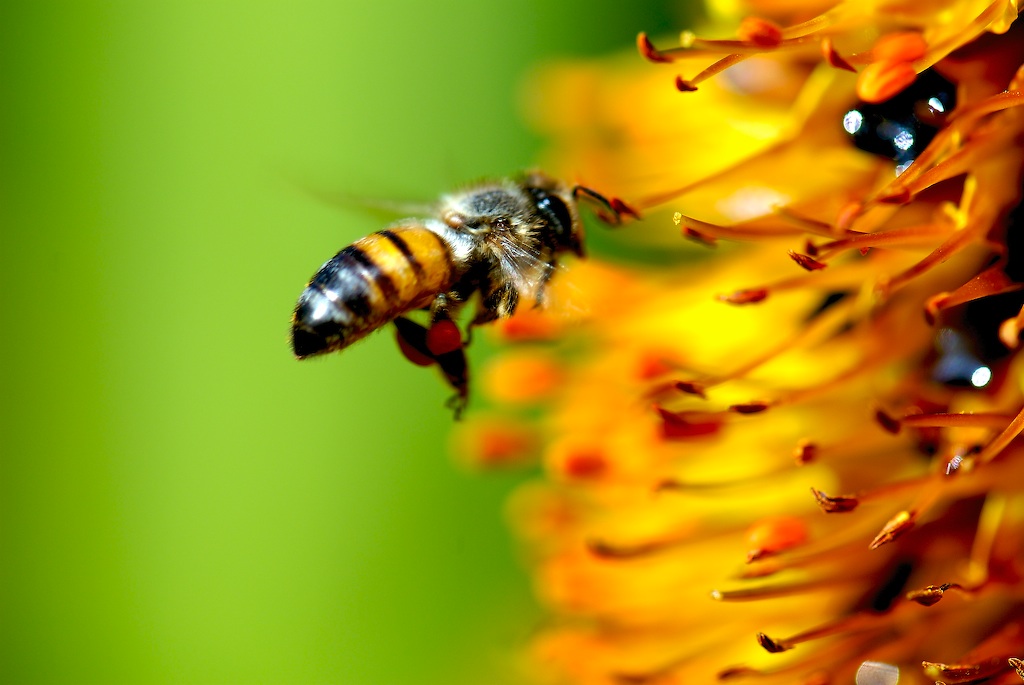
Here’s the tradeoff if you’re a male bee. The female honeybee does not need a partner to reproduce. She can lay an unfertilized egg, and it will hatch male. If she lays a fertilized egg, it will hatch female. Thus every male bee has one parent and every female bee, two. The male bee never has a father and never has a son. He can have friends, if he wants.
His reward is to anchor a delicate webbing. Tracing a male bee’s ancestry reveals a pattern of cracked glass: He has one parent, two grandparents, three great-grandparents, five great-great grandparents, eight great-great-great grandparents, and so on. Every male bee is the start of Fibonacci’s sequence: 1, 1, 2, 3, 5, 8, 13, 21, et cetera. Every number the sum of the two numbers before it. What Fibonacci said of rabbits, we can see in bees.
Fibonacci first posed it this way: If a newborn pair of rabbits is placed in a field to mate when they are one month old, and a new pair of rabbits repeats the sequence every month after, how many pairs will there be after a year? I don’t know the answer, but I like how he specified the rabbits have to be in a field. Writing a book meant to convince the public of the superiority of Hindu-Arabic mathematics, Fibonacci takes a moment to set the scene. What made him think it was important to put the rabbits in a field? Was it a memory from school? Some long-ago emphasis a favorite teacher placed on setting? Or was it the feeling, however latent, that these patterns respond to nature as it is, as much as they dictate how it will be?

 Scott Latta