Winner, 2014 Birmingham Arts Journal Electra Award for prose.
—
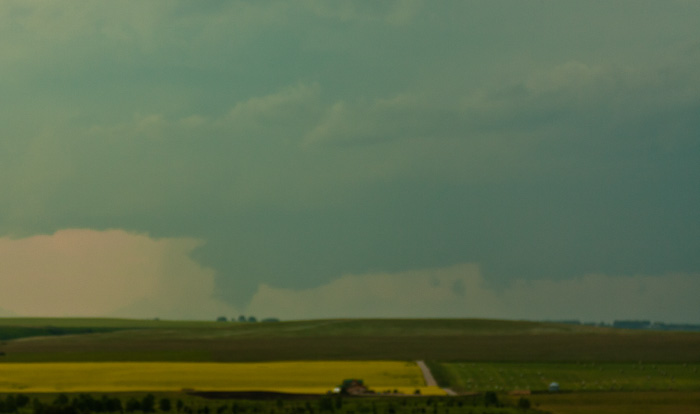
Consider the things that have to happen for a tornado to form. A tornado starts miles above us. In the atmosphere, a vortex of air called a mesocyclone rotates around a supercell thunderstorm way up out of reach, until heavy rainfall from the storm starts to drag the air down to our level. This cool atmospheric air hits the warm air of the storm and begins to rotate. That’s your wall cloud. By this point, the mesocyclone has shrunk from miles wide to a few hundred yards wide, and that newfound focus allows it to siphon air from a smaller and smaller target on the ground. Low atmospheric pressure pulls it down until dirt and trash and cows get sucked up and there you go.
But what of a mesocyclone? A mesocyclone needs a rotating updraft from a supercell. And a supercell can’t give it without just the right change in wind direction and wind speed. That wind may start hundreds of miles away, over the ocean even, rustling curtains and teasing veils until it hits the right cell. You see how this can carry on. The point is that in 1997, there were too many fourth graders at Valley Elementary School, and so our class, Miss Nelson’s class, was put in a trailer one hundred yards from the building, and then the storms came.
*
Within the monotony of my suburban childhood, I recalibrated the seasons. Summer was the only one that remained. After that came football season, then the Christmas season, and then right after, filling in the blanks until May, was always tornado season, the longest season. There are meteorological reasons why Alabama gets so many tornadoes. Sagging Gulf air, diving cold fronts, topographical flats of nothing that stretch back west into Mississippi and Arkansas and…well, a long way. But meteorological explanations are irrelevant to a ten-year-old in the same transitive way the explanations for why you live in Alabama are irrelevant: you live there because you do, and because you do, you get tornadoes. They’re like an HOA fee. It doesn’t do any good to help you get through the year.
To manage it, I became an intense meteorological autodidact. I think now that many children in Tornado Alley do this, and I think it’s because the more you learn about tornadoes, the more you realize the entire scheme is built on a randomness no adult can predict. It becomes up to you to figure it out. Severe weather played for me the same role war might have played had I grown up in a different place and time: some non-understandable thing that only made sense opaquely, some violent hypothetical that could strike at random and which no one could explain. Tornadoes were like pop-up parades that marched into town, clanging down the street and forcing everyone to stop what they were doing to pay attention. All kids have these things they obsess over. Tornadoes were mine. They were the disparate images I couldn’t impose on a narrative line. They were always out of reach.
I struggled to understand their pattern, which of course is only a loose pattern. It made sense for them to hit in summer, in the battery of a blow-in, two-o’clock thunderstorm. But summer wasn’t tornado weather: too hot, all the time hot. Tornadoes need instability, some quick switch of hot and cold. This made December a decent candidate, when warm Gulf winds blew north around Christmas. And it made a major one of spring, when the cold could snap back whenever.
Our family had two tornado stories. The first was at Gulf Shores, Alabama, before I was born, when my oldest brother Brad spotted a waterspout over the ocean and called out, “Look mommy, the letter I!” The story was mostly told as a joke, the punchline an itemized recounting of all the beach-gear they had just dragged down the boardwalk and then immediately had to slog back. The second was shortly after I was born, when one apparently came over the house in the middle of the night. I was grabbed and taken downstairs, the whole bit. Nothing happened beyond the uprooting of a large tree in the backyard, which my brothers christened a neighborhood tourist spot and charged money to climb around on. To this day I’ve never actually seen a tornado, but I’ve been under at least fifty tornado warnings. They’re always coming. The sky goes green, pine trees bend, a siren starts to go. An anxious meteorologist cuts in to whatever program I’m watching with a SEVERE WEATHER alert. But that’s as far as it ever went for me, and, as a kid with a weak stomach, that was more than far enough.
About sixty people on average are killed every year by tornadoes, or roughly the same number of people who are electrocuted by their own appliances. But that’s junk math. Four years ago tornadoes killed five hundred seventy-seven people, about the same number of people who were killed by elephants. That’s the chance game of the tornado. One year a sparky toaster, the next a stomping elephant. And that’s the trouble: we never know how long the odds are, just that they always catch up with a certain number of us.
1997 was a bad year for tornadoes. Not because they came—that was 98, 04, 11—but because they bluffed. A tornado’s bluff is as bad as its roar when you’re ten, and that year there were three, all late in the school year, all in the last hour before the bell, while we worked politely inside a twenty-by-ninety, American-made, aluminum-lined, double-wide trailer placed in a cluster of three in a parking lot far from the school. It held everything we needed. We were the only ones chance had excluded from the building, and so we grew close to one another, diplomats in a foreign post. One day Miss Nelson brought in a video of her winning a waterbed on The Price Is Right. We were hers and only hers.
Storm mornings started warm. A tornado started miles away, as a blue cloud edging over Chandalar Hill, as an extra ounce of hug from your mother. A warm wind through the bus window. A flittering glance of teachers whispering; half a sandwich you don’t want. On storm mornings, Miss Nelson loved us through distraction, scattering worksheets that allowed her to fiddle with the radio behind her desk and cut furrowed glances to the intercom. She would loiter with us in the building after lunch, twiddling around the library and the art wing before inching us toward the exit at the far end of the hall. A window there looked out over the parking lot, overgrown and hot beneath the trailers. We could hear the weatherman on TV in the teacher’s lounge. You learn your counties on a storm morning, or wish you had. When she could stall no more, Miss Nelson would push open the heavy door—were we under warning? just counties west, nothing yet—and lead us back outside, her bobbed hair blowing, to mark the time together.
*
Three bells will be the sign it’s on us. But we see it happen first. While we’re nose down in some assignment, scribbling away in silence, the trailer falls into shadow. The trees turn to jittery silhouettes. Miss Nelson puts on some music. The room goes ambient, yellow then purple then an unfamiliar gray as we sit without a word, just watching, until the room finally falls dark. Still. A long roll of thunder somewhere far off. We listen for the cue. Fat rain pops staccato on the aluminum roof. Miss Nelson has no phone out here. The intercom box tacked to the wall is her only connection to the building. She can buzz the office, but not without us hearing what she would ask them. Within seconds the rain becomes incessant, slapping our windows in sheets of water, wave beyond wave. A streak of lightning flashes the porthole windows and a blast rocks our wheels. One of us cries out.
Three bells sound from the school building. Miss Nelson rises and walks to the door, flinging it open in one motion. Her sleeve is soaked. She flicks her wrist toward the building, back and forth. The county warning sirens fire, climbing from a low hum to an air-raid scream. You can hear the different sirens wailing around the city, from Crosscreek to Chadwick, sentinels at our outposts. One is on a pole not twenty yards away, shrieking wildly over whatever it is Miss Nelson is telling us as we shuffle past her out the door. Inside the school, children are grabbing heavy books and slogging to the hall, giggling their way to safety. We are inconsolable, crying, filing out the trailer door like wobbly paratroopers into chaos. Miss Nelson’s mouth moves as she meets our faces, an offering of comfort perhaps as she lays a hand on each of our backs. I can’t hear her until I’m right beneath her. Lightning plays off the scattering bodies of my friends sprinting across the blacktop, and I feel her hand brush my shoulders. She’s only been repeating one word. Run. Run.
So much ground to cover in a hundred yards. So much to outrun. When we are young we believe there are safe places to shield us from the world; when we are older we know this is a myth, that all places get violated. As we age we watch them go, one by one. Our parents split up, a coyote takes the cat, the girl at school in the bicycle helmet drowns at the bottom of a lake. They leave us in an instant, and are gone forever, and after we lose them we can only imagine what it was like before we knew they could go. You can tuck your way to the hall and nestle beneath your science book, but a certain number of people have been caught by the odds. They’re coming through the door in sopping wet clothes, their eyes watery, having had something taken from them everyone else can still possess. It will happen to them twice more that year, then to everyone in the years ahead, our safe places breached by a doctor’s pursed lips, by the crash of shattering glass, by an officer’s knock at the door, by the words we need to talk, and off our brains will go to find a peaceful moment before it all changed, some memory, some morning, some place that’s still protected, and the only one we can land on is an ordinary childhood afternoon back in Miss Nelson’s trailer, when she cut the air conditioner on, unaware the janitor had been by to clean it, and how as she turned the knob the freezing air rushed through the vents, catching the last traces of soap, and thousands of bubbles began to pour out, on and on, over our laughter, over our heads, as she covered her mouth in wonder.

 Scott Latta